I remember the first time I faced a yard full of sticky, smearing clay. I wanted raised beds that drained quickly and fed plants well, but the thought of hiring a truckload of screened topsoil felt wasteful and expensive. Over the years I’ve developed and refined a method that turns heavy clay into productive, fast-draining raised beds without hauling in tons of topsoil. It’s practical, budget-friendly and uses a mix of physical changes and organic matter to create the structure plants love.
Why clay is a problem—and what really works
Clay holds nutrients well, but it also holds water and compacts easily. That means roots struggle for air and waterlogging becomes common. The two things plants need most from soil structure are porosity (air space) and crumb structure (stable aggregates). You don’t need to replace clay to get that—you need to build structure above it and improve its drainage and biology.
Overview of my approach
- Build a raised bed frame to give depth and keep edges tidy.
- Break and loosen the clay subsoil to allow vertical drainage.
- Create a layered fill—coarse drainage layer, chunky organic matter, then a rich top layer—using local materials wherever possible.
- Feed the soil biology with compost and cover crops so the structure improves over months and years.
Materials you’ll need
- Timber or cedar boards, rot-resistant sleepers, concrete blocks, or corrugated metal for the bed frame
- A sharp spade, digging fork, and/or a trenching shovel; for larger beds, a motorized soil auger or a rented mini-subsoiler helps
- Coarse drainage material: crushed rock, coarse gravel, recycled crushed brick, or builder’s grit (not fine sand)
- Bulky carbonaceous material: twiggy prunings, shredded branches, straw, cardboard, wood chip (well-aged)
- Quality compost and well-rotted manure
- Coarse horticultural grit or pumice/expanded clay aggregate (optional but helpful)
- Mulch: leaf mould, wood chips, or straw
- Optional: perforated drainpipe if you need faster evacuation for a very heavy site
Step-by-step build
I’ll walk you through a typical 1.2m (4ft) wide raised bed, but you can scale lengths as needed.
Step 1 — Choose location and build your frame
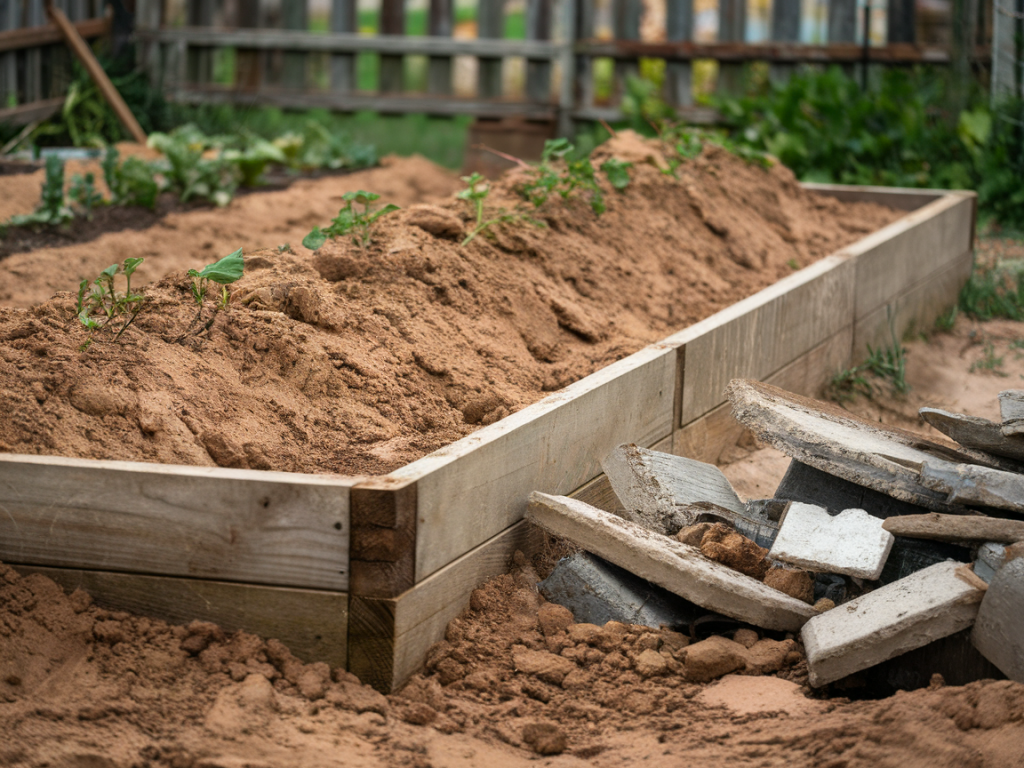
Place beds along the slope if you can; that helps gravity assist drainage. Use cedar or treated sleepers to make a box about 20–30cm (8–12") high for shallow beds, or 45–60cm (18–24") for deeper plantings. I usually aim for 30–45cm because it’s deep enough for most vegetables and perennials and avoids a huge material cost.
Step 2 — Loosen the clay subsoil
Rather than removing all the clay, I loosen it. Remove any turf and gently fork or spade the clay to a depth of 15–30cm (6–12") within the footprint of the bed. If your site is extremely compacted, rent a subsoiler or use a mattock to create vertical fractures down 30–45cm (12–18"). These channels become pathways for excess water and roots. Don’t mix in amendments at this stage—vertical channels are more effective when left open.
Step 3 — Add a coarse drainage layer
Place a 5–10cm (2–4") layer of coarse material on the loosened clay: crushed stone, recycled brick, or coarse gravel. This isn’t to create a water “pool,” but to give immediate macropores where water can collect briefly and drain into the subsoil fractures. Avoid fine sand—it packs and worsens drainage.
Step 4 — Build chunky organic “structural” layers
On top of the gravel add a thick (10–20cm / 4–8") layer of bulky organic matter—shredded branches, twigs, and coarse wood chips. This layer behaves a bit like a sponge at first and creates larger corridors of air. Over time the wood breaks down and feeds soil life, but initially the chunky stuff keeps the lower bed airy.
Step 5 — Add a transitional layer
Next add a layer (5–10cm / 2–4") of compost mixed with coarse grit or pumice. This helps blend the chunky base with the top planting medium, preventing a sharp boundary that roots can’t cross. I sometimes fold in 10–20% biochar (if available) for water retention and microbial habitat—brands like Terra Preta or locally produced biochar work well.
Step 6 — Finish with a rich planting mix
The top 15–20cm (6–8") should be a friable mix: good compost, some topsoil if you have it, and coarse horticultural grit. A mix I often use is 50% compost, 30% existing topsoil (if available), 20% coarse grit/pumice. If you don’t have topsoil, build with compost and grit—plants will quickly colonize and help create real topsoil from the compost and the underlying clay.
Optional: add a drainpipe for very stubborn sites
If your site is at risk of standing water after heavy rain, lay a short length of perforated drainpipe on the gravel layer, sloping toward a dry well or storm drain. Wrap it in landscape fabric to prevent silting. This is more work but can save plants and prevent root rot in high-rain areas.
Planting and immediate care
- Water deeply once after planting to settle materials, then allow the bed to dry slightly between waterings—this encourages roots to explore downward.
- Mulch with leaf mould or wood chips to conserve moisture and feed soil life as the mulch breaks down.
- Resist the urge to top-dress with a lot of fresh compost every month; layered beds settle and take a few seasons to mature. Light feedings and annual compost top-dressing are enough.
How long until the bed is “ready”?
Good news: your beds are usable right away for most plantings. Salads, herbs, brassicas, and many annuals do very well in year-one beds. Perennials and root vegetables will improve as the bed biology develops over the first 1–3 years. Over that time the chunky layer breaks down, microbial life increases and the clay below gets better structured by roots and worms.
Maintenance and seasonal tips
- Top-dress with 2–5cm (1–2") of compost each autumn; this builds fertility without compacting the bed.
- Plant cover crops (clover, vetch, buckwheat) in autumn/winter on unused beds to protect the soil, fix nitrogen and encourage root channels.
- If compaction returns, fork the surface in spring—avoid heavy machinery on beds while they’re young.
- Use drip irrigation or soaker hoses—these deliver water to roots and avoid puddling on the surface.
Common questions I get
Can I use untreated wood chips in the base? Yes—use well-aged chips for a large chunk layer. Fresh chips draw nitrogen while decomposing, so avoid mixing lots of fresh chips into the top 15cm where early plant roots rely on available nitrogen.
Is hauling in gravel expensive? Some, but often less costly than bulk screened topsoil. Check with local landscape yards; reclaimed brick or crushed concrete can be an economical coarse material if it’s clean and free of contaminants.
What about raised beds without frames? You can pile the same layers directly on the lawn or clay, using a wide no-frame hugelkultur-style mound. Frames help keep edges tidy and preserve the depth, which I prefer in small urban gardens.
With a little digging and layering, heavy clay becomes the foundation for a productive, fast-draining raised bed system that saves money and builds better soil over time. It’s one of my favorite projects because the transformation is dramatic and sustainable—and you don’t need to import mountains of soil to make your garden thrive.