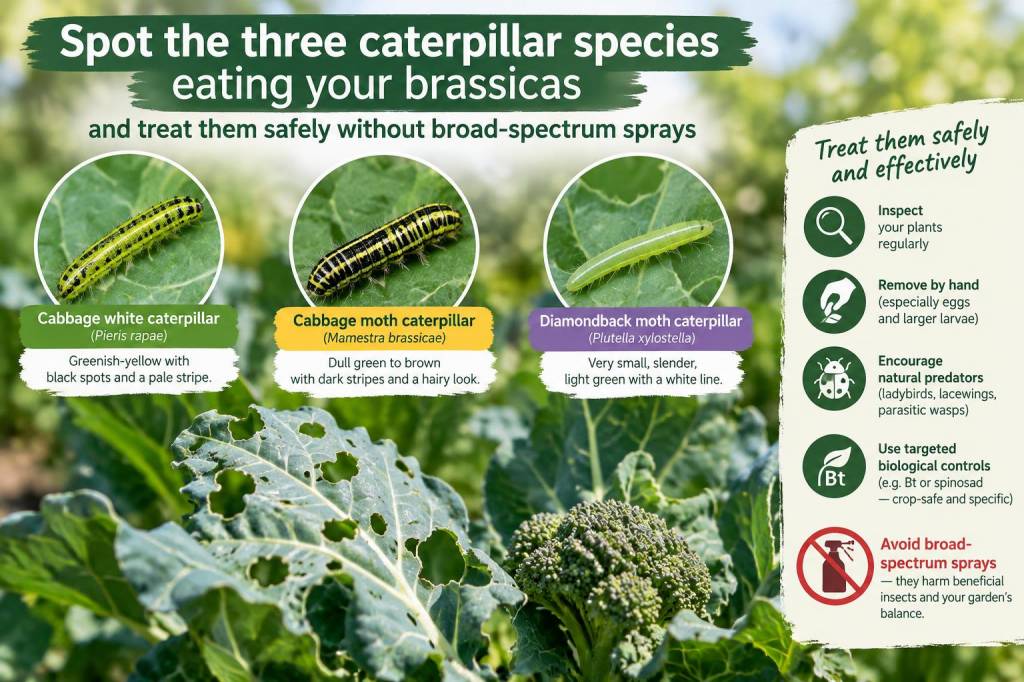
I remember the first time I found holes in my brassica leaves—little crescent bites and ragged edges on my kale and cabbage—and my heart sank. Brassicas are such reliable garden stars, and seeing them chewed by caterpillars is always frustrating. Over the years I’ve learned to spot the three most common caterpillar culprits and treat them in ways that protect the crop and the helpful insects I want to keep. Below I’ll walk you through how to identify each species, the kind of damage they cause, and practical, low‑impact ways to control them without reaching for broad‑spectrum sprays.
Which caterpillars are eating your brassicas?
Three species turn up most often in brassica beds: the Cabbage White caterpillar (young larvae of Pieris species), the Cabbage Looper, and the Diamondback Moth larva. They’re different in size, markings and feeding style—knowing which one you have makes treatment more effective.
- Cabbage White caterpillars (Pieris rapae and Pieris brassicae) — These are the plump, smooth green caterpillars you associate with white butterflies. Pieris rapae (small white) is the common pest; Pieris brassicae (large white) is bigger and can defoliate plants quickly. Look for a yellowish or greenish body with faint stripes on some individuals, and lots of large irregular holes in leaves. You’ll often spot white butterflies fluttering nearby.
- Cabbage Looper (Trichoplusia ni) — The classic “inchworm”‑style looper that arches its body as it moves. It’s smooth, green and can be larger than Cabbage White larvae. It tends to make ragged holes and can chew close to the stem. Loopers are nocturnal feeders so daytime damage may be the only sign you see.
- Diamondback Moth larva (Plutella xylostella) — Small (6–10 mm), skinny, pale green larvae that create tiny holes and a “windowpane” effect by eating leaf tissue between veins. Diamondback larvae are often hard to spot because they’re slender and hide under leaves. You might also find silk webbing and small dark frass pellets.
Quick ID table
| Feature | Cabbage White | Cabbage Looper | Diamondback Moth |
|---|---|---|---|
| Size / shape | Plump, 10–30 mm; smooth | Green, “inchworm” looping motion; up to 30 mm | Small, slender, 6–10 mm |
| Damage pattern | Large holes and ragged edges | Irregular holes, often near stems | Small holes; “windowpane” feeding |
| When active | Day and night; butterflies visible | Nocturnal feeders | Often hides under leaves; continuous |
| Notes | Often numerous; can defoliate quickly | Good climbers; may reach heads | Hard to spot; may become insecticide‑resistant |
Non‑spray, targeted control methods I use
Before I reach for any product I try the least disruptive approach. These methods reduce pest pressure and keep beneficial insects—ladybirds, parasitic wasps, lacewings—working in the bed.
- Row covers and mesh: I tent my brassicas with lightweight floating row cover (e.g., Agribon AG-30) immediately after transplanting. The mesh blocks egg‑laying butterflies and moths. Use a small‑mesh net if diamondback moths are a problem—DBM can be tiny and slip through wide weaves. Keep edges sealed to the ground with soil or stones.
- Handpicking: I check leaves twice weekly and remove sizable cabbage white larvae and loopers. Crushing, dropping into soapy water, or feeding to chickens are options. For small gardens this remains one of the most effective tactics.
- Trap cropping: Nasturtiums and radish varieties can distract moths and butterflies from tasty brassicas. Plant trap crops at the edge and remove or treat pest‑infested trap plants away from your main crop.
- Encourage predators and parasitoids: I plant alyssum, feverfew, coriander and native perennials to attract parasitic wasps (Cotesia spp. attack Pieris larvae) and tachinid flies. Avoid broad‑spectrum sprays that wipe these allies out.
When to use biological insecticides (and how)
When pest numbers rise, I choose targeted biological controls rather than broad‑spectrum insecticides. Two reliable options:
- Bacillus thuringiensis var. kurstaki (Bt) — Brand names include Dipel and Thuricide. Bt is taken orally by caterpillars and is specific to lepidopteran larvae. It’s safe for bees, birds and mammals. Apply in the evening (to avoid UV degradation), cover all leaf surfaces, and repeat every 7–10 days or after heavy rain. Bt works best on small to medium larvae; it’s less effective on fully grown caterpillars.
- Spinosad — An organic option (brands like Entrust) derived from soil bacteria. Spinosad affects the nervous system of caterpillars and some other pests. It’s more broad than Bt, so use it sparingly and avoid spraying flowering brassicas when bees are active. Apply in the early morning or evening, and follow label safety times for harvest.
Specific tips for each caterpillar
- Cabbage White — Row covers work extremely well, and Bt applied early knocks populations down. If you find many eggs on the undersides of leaves, scrape them off with a fingernail. Planting flowering herbs nearby attracts parasitic wasps that naturally reduce populations.
- Cabbage Looper — Because loopers are nocturnal, focus inspections in the morning when they may be resting under leaves. Bt and spinosad are effective; handpicking can be surprisingly productive since loopers are larger.
- Diamondback Moth — These can be the trickiest because they are tiny and can develop resistance to insecticides. Use tight mesh row covers and encourage natural enemies like predatory bugs and parasitoids (Diadegma and Cotesia species). Rotate control methods—Bt, cultural controls and trap crops—to avoid resistance.
Practical application notes and safety
A few practical things I do to make treatments work:
- Apply Bt and spinosad in the evening or early morning to reduce UV breakdown and avoid harming pollinators.
- Cover plants with row covers until they start to flower; remove covers briefly for pollination only if necessary and consider hand pollination for some crops.
- Wash leafy greens before eating if you’ve applied any product—follow label pre‑harvest intervals (PHI) for spinosad.
- Rotate control strategies across the season—relying solely on one method increases the risk of resistant pest populations.
Dealing with caterpillars on brassicas is a classic garden challenge, but with a bit of observation and the right mix of physical barriers, biologicals and habitat for beneficials, you can keep damage small without resorting to blanket insecticide sprays. If you want, tell me which brassicas are being hit in your garden and what the caterpillars look like—I’ll help you narrow it down and recommend a simple plan to try this week.