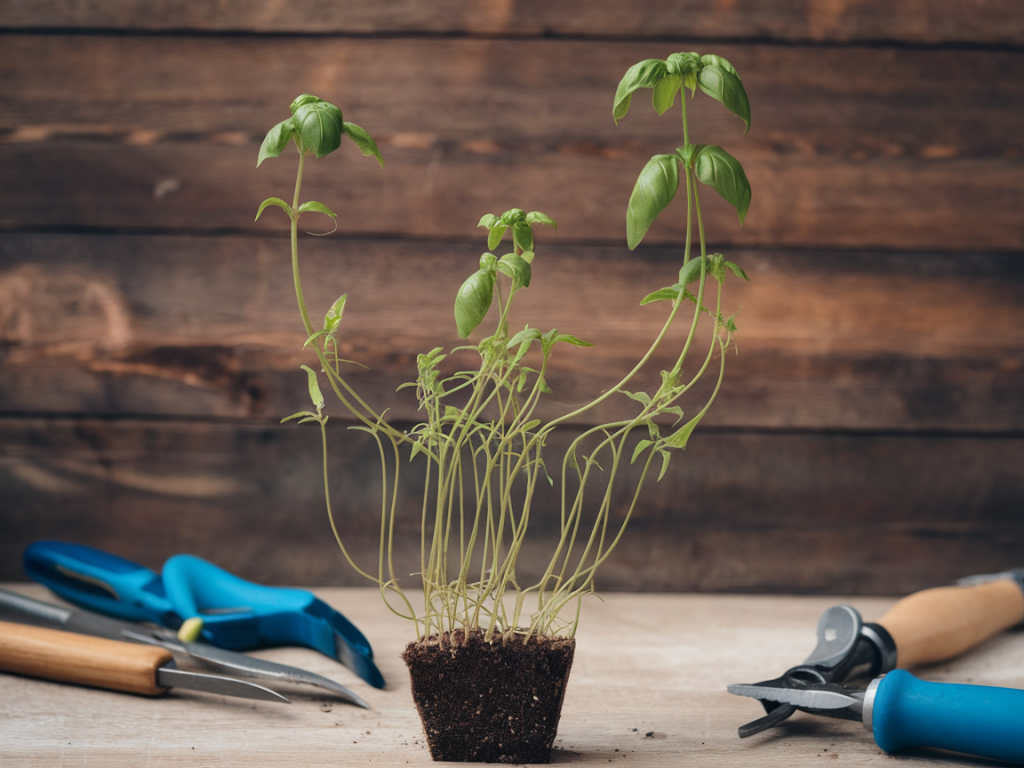
I love basil for its scent, speed and instant reward. But every summer I see the same sad sight in containers: tall, floppy stems with sparse leaves—basil that’s “leggy.” If your pots look like that, don’t pull them out yet. With a few straightforward steps you can revive leggy basil, encourage bushy growth and harvest a full summer of flavorful leaves. Below I share what I do when my basil stretches, including pruning, repotting, light fixes, feeding and how to propagate cuttings so you don’t lose a single plant.
Why basil goes leggy
Understanding the cause makes the solution easier. Basil stretches and becomes leggy for these common reasons:
- Insufficient light — Basil is a sun-lover. Less than 6 hours of direct sun or weak indoor light makes the plant reach for more light, producing long thin stems.
- Overcrowded pots — Crowding or poor airflow can stress plants so they invest in vertical growth rather than leafy growth.
- Lack of pruning — Basil responds to regular pinching. If you let it grow unhindered, it will put energy into a few tall stems and eventually flower.
- Nutrient imbalance — Too little nitrogen (leaf-building nutrient) or a depleted potting mix leads to thin growth.
- Long daylight during cooler months — Indoors or in cool spring, long days + low light intensity = legginess.
Quick triage: what to check first
Before you start hacking at stems, take a quick look:
- How many hours of direct sun does the pot get? Aim for 6+ hours.
- Is the pot shallow or rootbound? Check for roots circling the drainage hole.
- Is the foliage reaching or leaning heavily toward a window or light source?
- Are there flower buds forming? Flowering directs energy away from leaf production.
- How often have you fed and repotted the plant? Old potting mix needs refreshing yearly for good basil.
Step-by-step: revive leggy basil
Here’s the routine I use. Do it early in the morning or late afternoon when the plant is not stressed by hot sun.
Prune and pinch back hard
- Remove seed heads/flowers — If you see flower spikes, pinch them off immediately. Flowering makes leaves bitter and reduces foliage.
- Cut back to healthy growth — Using clean scissors or pruning shears, cut the main stems back by about one-third to two-thirds, depending on how leggy the plant is. Cut just above a pair of leaves or a leaf node — that’s where new shoots will emerge.
- Pinch, don’t just snip the tips — For softer, bushier regrowth, pinch out the tips of side shoots weekly. This encourages multiple branches instead of one tall stem.
- Sanitize your tools — Wipe scissors with rubbing alcohol between plants to avoid spreading disease.
Repot if rootbound or soil is tired
If your basil was in the same pot for more than a season, repotting can make a huge difference.
- Choose a pot 2–4 inches larger in diameter with good drainage.
- Use a fresh, free-draining potting mix. I like mixes labeled for containers or herb mixes; adding a handful of perlite helps drainage.
- Gently tease out circling roots and remove more than 1/3 of the old soil around the roots. If roots are very dense and circling, trim a few with clean scissors — this stimulates new feeder roots.
- Plant at the same depth it grew before and firm the soil gently. Water thoroughly so the soil settles around the roots.
Light and placement adjustments
Light is the most common culprit. Move your pot if possible:
- Outdoors: place basil in a spot with morning sun and some afternoon shade if your climate is very hot. In cooler regions, full sun is best.
- Indoors: place basil in the brightest south- or west-facing window. If you don’t have enough natural light, supplement with a 4000–6500K LED grow light hung 12–18 inches above the plant for 12–14 hours/day.
Watering and feeding—balanced, consistent care
Basil likes evenly moist but not waterlogged soil. Overwatering can produce floppy stems; underwatering stresses the plant and causes thin, wiry growth.
- Water when the top 1–2 cm of soil is dry. In summer that may be daily; in cooler weather less often.
- Fertilize lightly every 3–4 weeks with a balanced, water-soluble fertilizer (eg. 10-10-10) or use a slow-release organic pellet at potting time.
- Avoid high-nitrogen “green-up” fertilizers that can cause excessive soft growth susceptible to disease — balanced feeding is best.
Propagation from cuttings: turning decline into more plants
One beautiful thing about basil is how easily it roots from cuttings. When I prune, I never waste the cut stems.
- Strip the lower leaves off a 4–6 inch cutting and place the stem in a glass of water. Change the water every few days.
- Roots usually appear in 7–14 days. Once roots are 1–2 cm long, plant the cutting into potting mix.
- This gives you a fresh, compact plant to replace the leggy one or to grow alongside it.
Common mistakes to avoid
- Waiting too long — If you wait until the plant is almost bare, recovery takes longer. Prune at the first sign of legginess.
- Keeping it in a too-small pot — Rootbound plants struggle to produce lush foliage.
- Over-fertilizing — Too much fertilizer can encourage lush but weak growth that flops over.
- Ignoring pests — Aphids and whiteflies love tender basil. Check the undersides of leaves and blast pests off with a jet of water or treat with insecticidal soap if necessary.
When to start again: pruning calendar
Here’s a simple schedule I follow to keep basil compact and productive:
| Stage | Action | Frequency |
|---|---|---|
| Seedling (3–4 true leaves) | Pinch the top to promote branching | Once |
| Established plant | Harvest by cutting above a leaf node; pinch side shoots | Weekly |
| Signs of legginess | Hard prune back 1/3–2/3 and repot if needed | As needed |
Troubleshooting quick guide
Here are short fixes for specific symptoms:
- Thin stems, few leaves: More light, pinch tips, feed lightly.
- Wilting despite moist soil: Check drainage; repot with fresh mix and ensure pot has holes.
- Leaves yellowing: Possible nutrient deficiency or overwatering — reduce water and feed with balanced fertilizer.
- Sudden drop in leaves: Shock from transplant or high temperatures — move to cooler spot, reduce water stress.
If you want, I can walk you through a recovery plan for a specific pot—tell me about its size, how much sun it gets and how long you’ve had the plant, and I’ll suggest exact pruning cuts and a repotting recipe. Basil is forgiving; with a bit of ruthless pruning and the right light, it almost always bounces back into a lush, aromatic powerhouse for pesto, salads and summer snacking.